
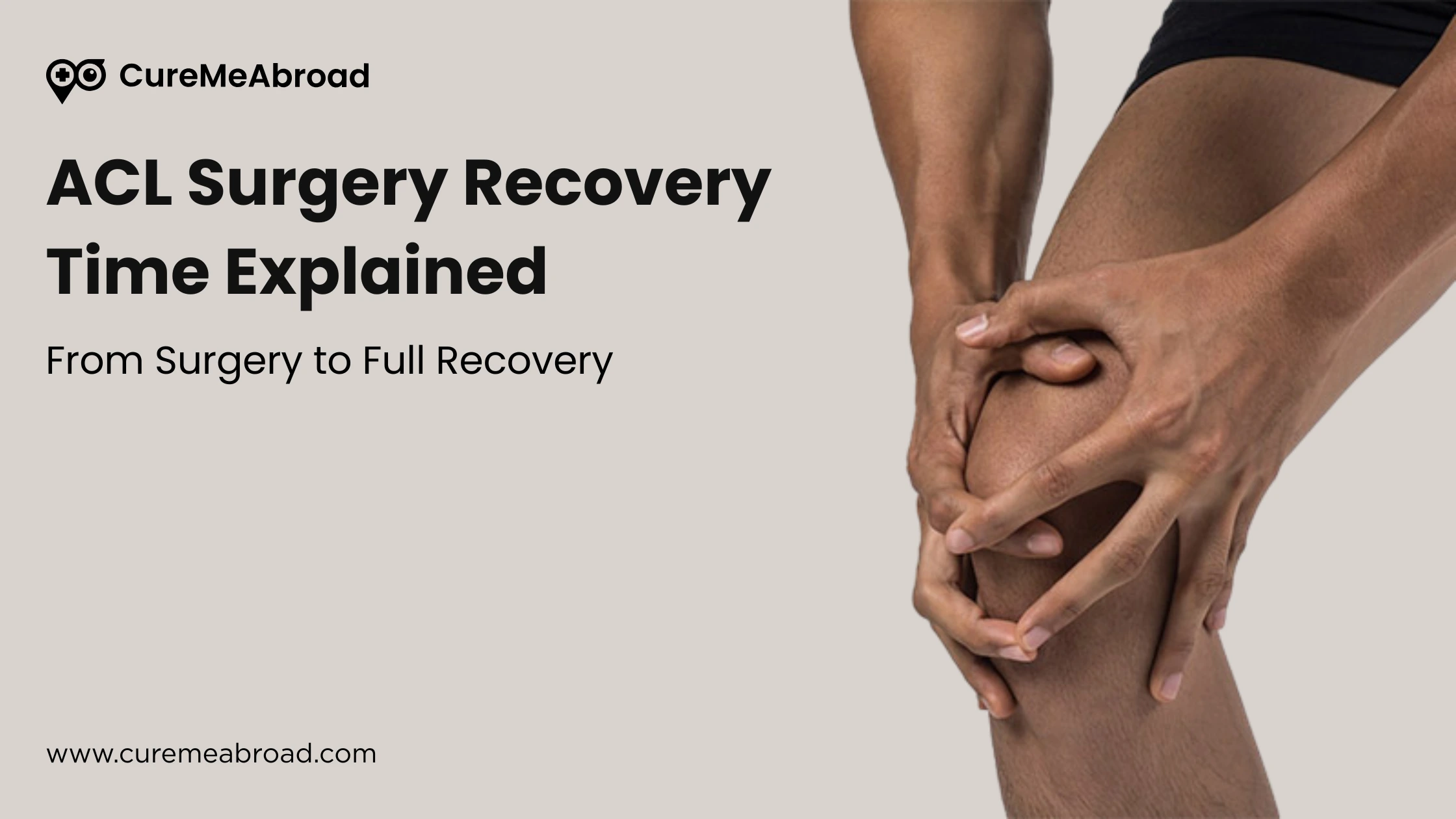
Recovery from an ACL surgery is not just about the physical healing of a ligament. It also involves regaining your confidence, strength, stability, and trust in your knees. If you are a sportsperson resuming your games or a person who simply wants to walk, go up stairs or live pain-free, the information about ACL surgery recovery time can be a great aid in making your recovery journey less intimidating.
Although many patients are interested in learning ‘How long will it take?’, the answer to this question would actually be ‘What does every stage of recovery entail?’ This, because recovery, not just time, involves rehabilitation, hard work, commitment, and healing potential.
The following will inform you about ACL surgery recovery in a clear and concise way. You can be sure that you understand just what will happen because all topics are addressed in an easy-to understand way.
Let’s take a quick glance at ACL Surgery Recovery Timeline:
- 1 to 2 weeks: Rest, control swelling, avoid or very limited weight, bearing
- 3 to 6 weeks: Partial weight, bearing, slow movements, physiotherapy starts
- 6 to 12 weeks: Full weight, bearing, strength and coordination exercises
- 3 to 6 months: Regular walking, resuming light activities
- 6 to 12 months: Complete recovery for sports and heavy work
Read the full article to learn in detail about ACL surgery procedure, recovery, costs and top hospitals in the world.
What is ACL Surgery?
The anterior cruciate ligament, also known as the ACL, is a short and thick piece of tissue found in the middle part of one's knee. The main function of the ACL is responsible for stabilizing the leg and helping it rotate or move forward and backward. A torn ACL is considered one of the most common injuries one may experience with regard to ligaments. A torn ACL may also affect how one walks and how one's leg or knee is able to move. The unfortunate part about a torn ACL is that it does not have the ability to heal, unlike some of the ligaments found in one's knee.
When ACL Surgery Is Needed?
Not all individuals suffering a torn ACL will need surgery, however, many will benefit from it. When to have surgery usually depends on your level of activity that you want to return to and your age.
If you are an elderly individual and just want to go for a walk or exercise at a gym, physical therapy after a torn ACL can get you back to normal. An individual who is willing to get back to sports like tennis or golf, or is young and has a lifelong plan of exercising ahead, it makes perfect sense to have a fully functional ACL which is going to stabilize your whole body and thus your doctor may advise surgery.
In most cases of torn ACL, the surgeons decide to do a reconstruction procedure. The reconstructive surgery creates an entirely new ACL by using the tissue from any part of one's body, e.g. hamstring, patellar tendon, or quadriceps tendon, or from a transplant tissue.
What to Expect After ACL Surgery?
Physical therapists are the ones who work with the individuals after the ACL reconstruction surgery in order to restore the individual’s strength to what it was before the injury took place. However, to restore the lost strength in the individual’s body, the knee needs to overcome the inflammation in the ligament in order to allow the limbs to move again. How long it takes varies based on the level of the reconstructive surgery performed.
Crucial Elements for an Effective Rehabilitation Process
1. Compatibility with Physical Therapy
Skipping physical therapy sessions will not allow you to get the maximum benefit and will eventually cause the occurrence of the injuries again. A rehab program is a must if you want to get better and eventually heal completely.
2. Strength Training and Muscle Imbalances Correction
A balanced curriculum comprises:
- Quadriceps and hamstring exercises to strengthen the knee
- Glute activation exercises for preventing excessive knee valgus during stance and movement
- Stabilization exercises to enhance biomechanics
3. Mental and Psychological Recovery
Fear of injury can also be a factor that lowers an athlete's confidence level. A variety of treatments such as sports psychology therapy, visualization of the movements, and gradual exposure to the sports activities may help in overcoming knee insecurity.
4. Proper Nutrition for Healing
A balanced diet helps to accelerate the process of repairing tissues. The foods that should be consumed include:
- Lean proteins like chicken or fish to help rebuild muscles
- Antioxidant-rich vegetables like Spinach to reduce inflammation
- Healthy fats like avocado and nuts for joint lubrication.
Common Mistakes in ACL Recovery that Can Cause Delays
Returning to Sport Too Quickly
Returning to sport before full recovery increases the risk of re-injury by 50% within two years.
Neglecting Rehab Exercises
Inadequate training in strength and stability delays recovery.
Skipped Mental Training
Many athletes underestimate the psychological aftermath of ACL injuries. Building mental resilience is just as important as regaining physical strength.
Failure to Adhere to Medical Clearance Guidelines
Premature return without clearance could lead to chronic knee instability.
ACL Surgery Recovery Timeline
Physical therapists would like you to meet some milestones at some stage in your recovery, again, not the same for everyone. Your physical therapists would have you perform some tests at 6 weeks, 12 weeks, 6 months, and 9 months post-surgery. These tests allow your physical therapists to know that you are doing well in terms of your recovery, that you are restoring your knee function after surgery.
But for most individuals, complete recovery can be accomplished relatively quickly. Generally speaking, by the 3-month point, you're pretty much going about your regular routine.
Phases Of ACL Reconstruction Recovery
Phase 1: Immediate post-surgery (0-2 Days)
Area of Emphasis: Pain and Swelling Care Using the RICE Principle (Rest, Ice, Compression, and Elevation)
- Gentle range-of-motion exercises to prevent stiffness
- Non-weight-bearing on the affected side, unless cleared by a physician to bear weight
Phase 2: Early Rehab (2-6 weeks)
- Controlled strengthening exercises for the quadriceps and hamstrings
- Mobility and stability exercise with physical therapist
- Gradual weight-bearing with crutches, as advised by doctors
Phase 3: Strength & Stability (6-12 Weeks)
- Progressive resistance exercise for lower-body strength
- Proprioception, balance exercises to enhance joint stability
- Addition of low impact exercise like cycling or swimming
Phase 4: Sport-Specific Training (3-6 Weeks)
- Agility and endurance exercises specific to sports being played by athletes
- Jumping exercise techniques and cutting drills for players participating in pivot-intensive sports
- Power tests for comparison of injured leg with uninjured leg
Phase 5: Return-to-Play Testing (6-9 Weeks)
Functional movement tests, including single-leg hop tests and Y-balance tests Assessments for psychological readiness to overcome fear of re-injury Medical clearance by sports therapist or orthopedic specialist.
Flexibility and Range of Motion Exercises
Flexibility exercises or Range of motion (ROM) exercises are equally important in the rehabilitation of an injured ACL. Full extension and flexion of the knee enable a person to walk normally without any hampers of injury-related compensation.
Role of Knee Mobility
Without full extension of the knee joints, it will be hard to walk, run, or squat. Limited flexion impairs the function of actions such as climbing stairs and the act of sitting. This can cause stiffening, aches, and prolonged healing of the body.
Techniques for ACL Recovery through Stretching
Heel Slides: Sit with your legs out and move your affected leg towards your body. Hold it and then repeat.
Seated knee extensions: Sit on a chair and extend your knee, holding it for a few seconds before lowering it down.
Standing Quadriceps Stretch: Stand on your unaffected leg, and using your affected leg, try to bring your heel towards your buttocks.
Balancing and Proprioception Training
Proprioception is the body's ability to perceive its own position and movement. Proprioception is usually lost after an ACL injury and is a great risk factor for re-injuries.
The Importance Of Balance Training are:
- Provides increased support for knee stability.
- Protects against excessive motion that may otherwise strain the ACL.
- Enhances coordination for activities such as running, jumping, etc.
The Best Balance Exercises for ACL Rehabilitation:
Single-Leg Stance The affected leg is to be placed on the affected side, and then the patient is to stand on that leg for 30 seconds.
Bosu Ball Squats Stand on Bosu balls in a position to carry out squats.
Dynamic Balance Exercises The lateral movement, hopping, and agility exercises can enhance reaction time.
Use of Aquatherapy in ACL Rehabilitations
In the initial stage of rehabilitation, aqua therapy could be an added modality to enhance subjective knee function. To avoid any risk to the operated area and to ensure that the area is fully cured to start the water-based fitness regimen, water treatment should be started in three to four weeks.
Preventing Re-Injury Following ACL Rehab
Preventing a second ACL injury is as important as recovery. Those who experience an ACL tear may be at a high risk of tearing it again. Here are two important things to keep in mind to prevent re-injury.
Proper Movement Mechanics Avoid poor landing techniques. Land with knees slightly bent and pointing toward the toes. This will help reinforce the hips and core, which empowers the latter by letting it regulate the movement of the knees. Gradually return to cutting and pivoting movements. This can be in the form of small sprints: start slowly and gradually increase the intensity.
Resume Strength Training
Continue strength training even after rehab ends. Focus on single-limb exercises to avoid imbalance. Incorporate plyometric drills that will enhance power and coordination.
The Psychological Aspect of ACL Rehabilitation
Recovery from an ACL tear is not only a physical task but also a mental challenge. Common barriers include a fear of re-injury and frustrations with poor progress.
Mental Challenges After an ACL Tear
- Anxiety due to returning to sports.
- Depression due to loss of mobility and restriction of activities.
- Lack of motivation after long rehab period
Strategies to Keep Motivated
- Setting realistic goals and celebrating small achievements.
- Consult a sports psychologist if necessary.
- Stick to the team activities, even when not playing.
Return-to-Sport Readiness: How to Know If You’re Cleared
Prior to returning to competitive sports, the athlete must go through these crucial tests:
Functional Movement Tests Single-leg hop test, Y balance test
Strength Symmetry The affected leg must have at least 90% strength of the unaffected leg
No Residual Pain or Swelling Persistent inflammation can present an important warning sign
Psychological Confidence Lack of confidence in movement increases injury risk
Best Countries and Hospitals for ACL Surgery Recovery
Below we can find a table which gives a quick look at the top countries and hospitals that provide the best rehabilitation for ACL surgery. These centres are internationally accredited and use the latest sports rehabilitation equipment and techniques.
| Country | Top Hospital / Clinic |
|---|---|
| USA | NYU Langone Orthopedic Hospital |
| Germany | Charité University Hospital Berlin |
| France | Fondation Hopale |
| Poland | Carolina Hospital |
| Turkey | Acibadem International Hospital |
| Malaysia | Prince Court Medical Centre |
| Singapore | Mount Elizabeth Novena Hospital |
| India | KEM Hospital |
| Thailand | Vejthani Hospital |
The recovery period from an ACL surgical procedure is no race, it’s a journey where patience and consistency will be richly rewarded. As opposed to focusing on crossing the endpoint to resume sports activity or return to regular life, the ultimate success can be found in the efficiency with which the leg heals.
While most patients can be able to walk without any discomfort in a few weeks, carry out their usual activities in a few months, and get back to sporting activities between 9-12 months, your own “bodily wisdom”, along with expert advice, can work wonders for your speedy recovery.
In conclusion, when done properly in a positive-minded patient, surgery for an ACL injury has the potential to return not only function to a knee but also its associated confidence.
Frequently Asked Questions
How long does it take to completely recover from ACL surgery? Complete recovery is usually between 9 and 12 months, particularly for athletes going back to high, impact sports.
Could intense physiotherapy make ACL recovery faster? Doing a structured physiotherapy program is certainly helpful, but the body still requires time to heal. If you force the injured tissue to work too hard too soon, your recovery might take even longer.
Is it common to still experience pain months after ACL surgery? It is possible for mild pain or tightness to be present, however, if the pain does not go away, a specialist should be consulted.
How long after ACL surgery can I start running? Patients usually start gentle running at 3 to 4 months, this also depends on how strong and stable the knee is.
Will my knee feel normal at some point? With good rehab, most individuals regain knee function that is almost normal and are able to do as much physically as they did before.
What are the consequences of skipping physiotherapy? If you don't do your rehab properly, you may end up with a stiff, weak and unstable knee that can get injured again.
Is it true that non-athletes have a harder time recovering from ACL surgery? Actually, not really. Being an athlete or not doesn't have that much of an impact on recovery. Instead, things like motivation, doing your rehab well, and being generally healthy have a greater influence on the outcome.
References
“ACL Tear.” Cleveland Clinic, 23 Dec. 2025{: rel="nofollow"}
Sports Orthopedics Institute. Sports Orthopedics Institute | Excellence in Motion. 6 June 2025{: rel="nofollow"}
Mdt, Patrick Vignona Pt, Mspt, Scs, Cert. “ACL Surgery Recovery: Everything You Need to Know.” Hospital for Special Surgery, 29 Sept. 2023{: rel="nofollow"}
“ACL Injury Recovery: A Guide to Safely Returning to Sports.” Aster{: rel="nofollow"}